What Is an AI-Ready Website — and Why Your Small Business Needs One in 2026
AI search and AI assistants are changing how customers find businesses. An AI-ready website is structured so machines can read it, rank it, and recommend it. Here is what that means in plain English.
If you have heard the term "AI-ready website" and wondered whether it is just another buzzword, it is not. It describes a real shift in how Google's AI overviews, ChatGPT, and voice assistants decide which businesses to recommend. The good news: most of what makes a website AI-ready also makes it faster and better for human visitors.
What "AI-ready" actually means
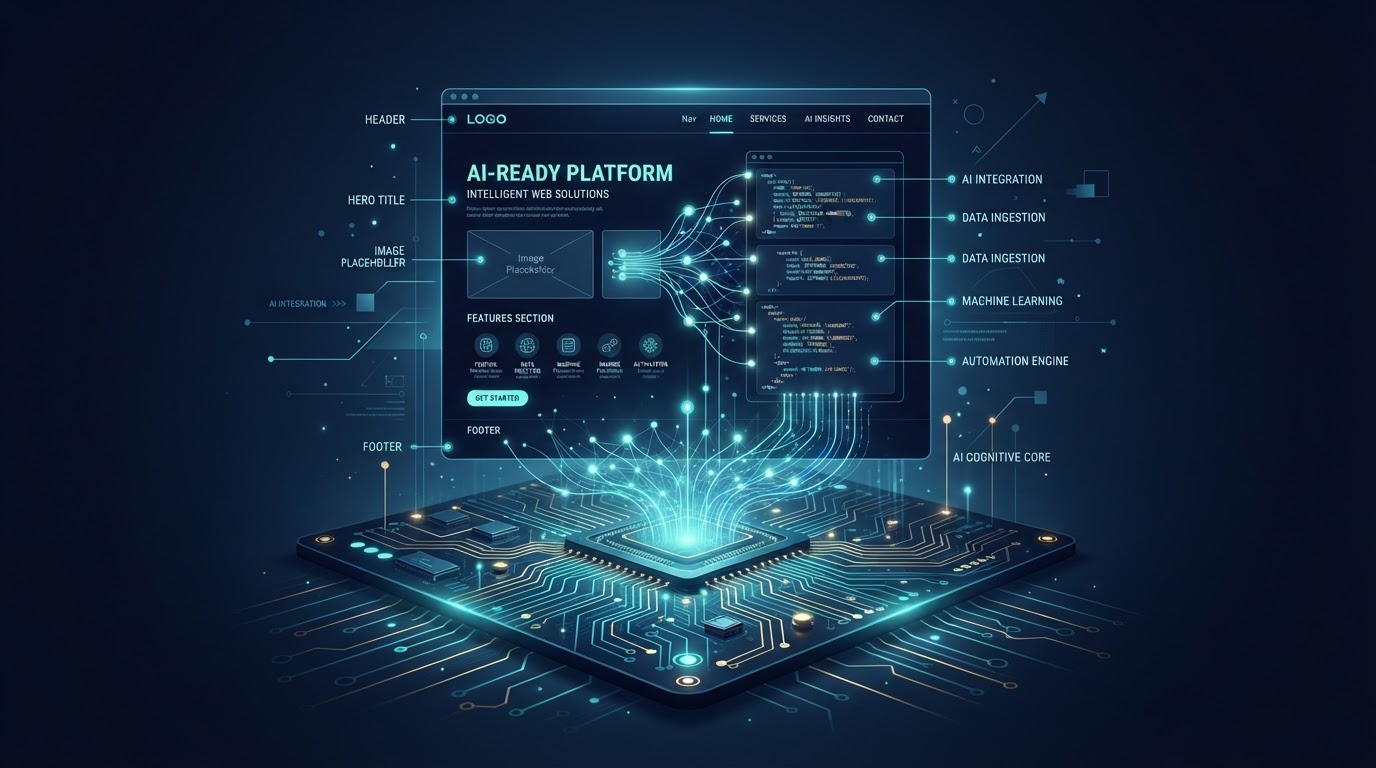
AI assistants do not read a website the way you do. They do not see your hero image or feel your brand colours. They read the underlying code and structure: your semantic HTML, your structured data (schema markup), your page titles, and your meta descriptions. An AI-ready website is one where that underlying layer is clean, complete, and unambiguous so a machine can confidently answer questions about your business.
Think of it like this: a human visitor can guess that "Define Marketing" is a marketing agency from the logo and the heading. An AI assistant needs to be told, explicitly and in a standard format, that this is a marketing agency in Logan Reserve, Queensland, offering website design, CRM automation, and branding — and it needs that information in the same place every time.
The four things that make a website AI-ready
1. Structured data (schema markup)
Structured data is the machine-readable summary of your page. It tells search engines and AI assistants what your business is, what services you offer, where you are located, what your opening hours are, and what your reviews look like. Without it, an AI assistant is guessing. With it, an AI assistant can recommend you with confidence.
Every page on this site carries JSON-LD structured data — Organisation, Service, LocalBusiness, Article, FAQ, and BreadcrumbList schema — for exactly this reason.
2. Clean, semantic HTML
AI assistants parse HTML to understand a page. Messy code, nested divs with no labels, and content stuffed into generic containers all make it harder for a machine to work out what matters. Clean semantic HTML — proper headings, descriptive alt text, labelled form fields — lets the machine extract the meaning without effort.
3. Fast load times
Google's AI overviews and Core Web Vitals both reward speed. A page that loads in under two seconds is more likely to be read by a human and summarised by an AI. Slow pages get skipped by both.
4. Consistent, crawlable information
Your business name, address, phone number, and services should be identical everywhere they appear — on your website, your Google Business Profile, your social profiles, and your directory listings. This is called NAP consistency, and it is one of the strongest local SEO signals there is. Inconsistent information confuses both humans and machines.
Why this matters for being found in 2026
Google's AI overviews (the AI-generated summaries that appear above traditional search results) are now the default for many commercial searches. If your website is not structured for AI to read, you will not appear in those summaries — even if you rank on page one organically. Being AI-ready is no longer optional; it is the new baseline for being found.
The simplest first steps any business can take this month
- Add Organisation and LocalBusiness schema to your homepage (your web developer or a tool like Google's Structured Data Markup Helper can do this in an hour).
- Make sure your business name, address, and phone number are identical on your website, your Google Business Profile, and your Facebook page.
- Run your site through Google PageSpeed Insights and fix anything over a 3-second load time.
- Write a one-paragraph description of what you do in plain English — no jargon — and put it in your homepage meta description.
If that sounds like a lot, it is — and it is exactly what we do for every client. Book a strategy call and we will audit your site's AI-readiness as part of the conversation.
Website design, CRM automation & branding →
Your local teamWebsite design & CRM across Logan, Brisbane & Australia →
Want results like this for your business?
Talk to Martin & Tabitha about website design, CRM automation and branding — taking the overwhelm out of marketing your business.